Monday, March 13, 2017

Calibrating monitors for HLG-1.2 High Dynamic Range working

I've now done a couple of Sony BVM-X300 (4k/HDR OLED panel) monitors for HDR-TV deliverables to the BBC. The Beeb are behind the Hybrid Log Gamma standard, currently at 1.2 for broadcast. It's benefits over Dolby's 10-bit version of their Vision HDR system (also called DolbyPQ) are many and rather splendidly the DVB as well as most manufacturers are now behind HLG. I'll write further about why a scene-referred system is a better bet for domestic TV than a display-referred one (like DolbyPQ) but I just wanted to get down some notes on monitor calibration for HLG.

So first up you need to get the monitor into HDR mode (the correct one! As of v.2 firmware the X300 supports several; the camera gammas; CLog, CLog2, SLog & SLog3 as well as the deliverable standards; SMPTE-2084 (DolbyPQ) as well as SMPTE-2100 (HLG 1.2).


You'll notice the EOTF setting (lit. "Electronic - Optical Transfer Function") is NOT set for HLG 1.2; this available but in the current v. 2.0 firmware it is wrong. Select HLG (Variable), click the know again and dial in 1.2

Next up display a 50% grey field (100% can't be done as the monitor power-limits to stop 1,000Cd/m2 being displayed across a lot of the screen) and point your probe at the display. Remember that unlike DCI-P3 we are still at the 6504K white point of tele. However - at 50% grey we should be seeing low-50's Cd/m2 being emitted from the screen. 
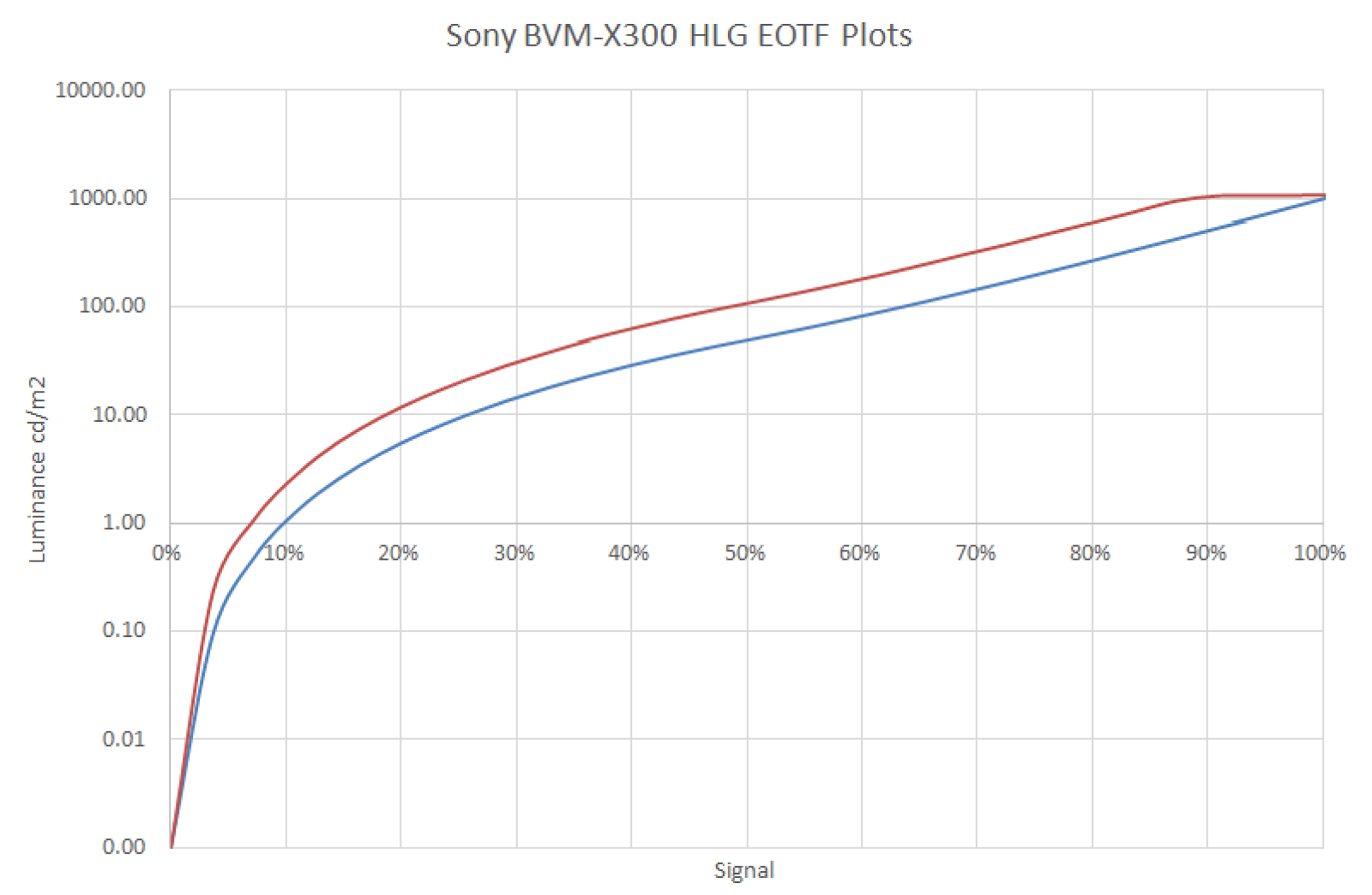

You might have previously heard Sony's "best practise" (sic) advice of setting 50% grey to 100Cd/m2 but this is wrong. Look at the graph; this is the result of profiling an X300 (and they all seem to do it consistently) and notice what happens over the last couple of hundred Candelas at the top end. If you set 50% grey to 100Cd/m2 you get loss of detail in the specular highlights. For the correctly 1.2 HLG curve you need to set 50% to around 50Cd/m2 to 55Cd/m2- remember the Y-axis on this graph is logarithmic. 

The one display I had previously followed the Sony advice for was sufficiently out of it's linear range that the dark-greys drifted red minutes after I finished adjusting the monitor and (like all OLEDs) the noise in their blacks is sufficient to make the final tweak to 6504k hard work - the Klein probe was having to average over 32 reads to accommodate the OLED panel. Remember - the K10A is accurate to less than 0.001 Cd/m2 and not the 1.0 Cd/m2 it reads at 10% up the curve of HLG 1.2

So - once you have those under your belt you can PLUGE the display to set blacks correctly for the room (what did I say about scene/display referred?!) and then set about getting the deep greys and the 50% colour balance correct. I've done this now on two X300s with BBC R&D engineers in attendance and they have given this method their blessing!

For a probe I was using a Klein K10A with Klein's own ChromaSurf software. If I get the chance to profile an X300 for myself I will do it with LightSpaceCMS - still the choice of champions for display profiling and LUT-building. They also have an excellent article introducing HDR.

Friday, February 24, 2017

My favorite music podcasts

For me the last ten or twelve years has seen an almost 100% move to on-demand radio listening. The only live radio I listen to is the Today Programme on Radio 4 whilst having breakfast; I do put Six Music on at the workshop for the wiring guys, but for me (even shows produced for radio) are consumed as downloads.  Here are the things about music that I never miss.

  1. BBC Mastertapes - John Wilson presents artists talking about how they recorded a classic album. The show slips in two ("The A Side" and "The B Side") with Wilson doing the interview in the first half hour and then the assembled fans asking questions in the second. Wilson is clearly a music fanatic and never fails to engage with the artist. It comes from BBC Maida Vale and there are currently 74 hours for you to catch up on! Billy Bragg's "Talking with the Tax Man about Poetry" was the first episode back in 2012 and the glorious thing about it is I've discovered some records I never knew about and been really surprised by how much I enjoyed artists I thought were not my thing. Rufus Wainwright is a prime example. The artists always do a minimal arrangement of the well known numbers off the album their talking about and so of course the format tends to favour performers who can do it live.
  2. Between the Liner Notes - A podcast (not produced for radio) that takes some aspect of the music industry and devotes an hour to it. Really engaging and has a big radio rockumentary production feel. For me - a Gen X'er coming of age in the eighties the episode on MTV is required listening.
  3. Music City Roots - this is a "proper" radio show out of Nashville. I like it because Mike Farris has a show (which sometimes makes it into the podcast feed) but the main man is Jim Lauderdale who is a real champion of Alt-country and Americana.
  4. Sodajerker on Songwriting - Sodajerker is a songwriting team from Liverpool in the United Kingdom. Founded by co-writers Simon Barber and Brian O’Connor who, like most jobbing musos, have to suppliment their work with teaching and podcasting. They have had some great guests in their (so far 97) shows. In classic podcast fashion the length varies and the best one so far (for my money) has been Paul Simon although I've enjoyed all of them (check out ep.80 - Marcus Miller).
  5. The Bored-Again Christian podcast - a notable mention even though he stopped making shows five years ago. I discovered a few artists via this podcast; Sufjan Stevens and Danielson to name a couple.
Podcasting is the answer to the dumb mass-market HeartFM/TalkFM/LBC type radio. It's no coincidence that you don't get anything like this kind of treatment of musicians and who they do on commercial radio.

Monday, January 16, 2017

LUTs are sometimes not the answer.

As I often tell people; a LUT can only reduce the dynamic range of a display. For the most part that needn't matter, particularly if you have the whole of the DCI-P3 (or a decent chunk of Rec.2020) in your monitor. Applying a look-LUT to simulate a delivery style is one thing but increasingly people see LUTs as the first answer to monitor calibration rather than getting the display to as close-as-possible before profiling/creating a LUT. Hugh and I did a podcast on the subject.

A problem I've recently discovered with a monitor's internal Rec.709 LUT is that although the monitor has a huge gamut in it's native mode (which you can see from this recording of ChromaSurf's output) but the 709 presets have trouble.


Notice how it can reach a full green value of 0.1879, 0.7317 (Rec.2020 calls for 0.170,0.797); you'd think there would be absolutely no trouble getting Rec.709 right, and in fairness the primaries are fine. BUT, when I use both primary and secondary colour ramps;


I wind up with some distinctly funny looking banding in the secondary colours.


On this 'phone photo it is particularly noticeable in the yellows, but it's there in the cyan and magenta ramps as well. The fault isn't there when the monitor is in native mode (or indeed P3, NTSC or EBU), only Rec.709 (ironically the only colour space we really need for TV!).
So, I'll have to profile it in native mode and spin a 17-point 709 LUT as the one from the manufacturer is clearly got problems.

Another way of stress-testing a LUT is to use the TrueColor LUT stress test image.


Thursday, December 22, 2016

Power supply toroid in Mackie SRM450 PA loudspeakers

A friend brought one of these very common PA powered loudspeakers over to the workshop. An internal T4A mains fuse had blown and when I replaced it and re-powered there was a very loud 50hz hum for a few seconds and the fuse in the power cord blew. I assumed it was the audio path that was making the noise and I assumed that one one the probably faults was a short/open de-coupling capacitor that was letting 50hz through to the audio stage.

I found the schematic at Mackie-SRM450 actspk.zip (although this is for the rev.C of the board, but the PSU appears not to have changed).

So - I made sure both fuses were good and with Dave Jones's words "thou shall always check the rails" in my ears I disconnected the output of the large toroid from the two rectifiers/smoothing caps and tried again. I figured I'd make sure the o/p of the transformer was good (there is some de-coupling on the primary). However I got the same loud 50hz for a couple of seconds and one of the fuses failed. The toroid was also noticeably warmer than it had been! So - checking the DC resistance of the primary side showed it to be less than six ohms (so it was pulling an inrush of at least 40A!).


A quick flail around the web showed that the transformer is a known weak point of this design.

 The real bummer is that the transformer isn't stocked by Mackie (or indeed anyone else) and the folks at Save My Light only do a minimum order (ten pieces) from the Chinese factory that wind them when they have enough orders (and the chap there told me he sells an average of two a year).
So, do I just wait or pay him the thousand quid to have ten made?!

Time to keep my eye on eBay for a hopefully working second hand replacement?

UPDATE 16/01/2017: 

So after lots of flailing around the web and finding a few reclaimed ones for more than £150 I came across AJAudio on eBay (Alex Mathew sales@ajaudio.co.uk was super-helpful) and he sold me one for £99.
Job done.

For info - the failed toroid had around 5 ohms DC impedance across the primary whereas the replacement has 8.5 ohms.

It's been shaking the workshop with loud music all afternoon!

Friday, November 25, 2016

My favorite rockumentaries of all time

  1. "Still Bill"
    The film follows the life of Bill Withers, from his roots in West Virginia to his career in the United States Navy, to his famed musical career and post-retirement family life.

  2. "Sound City"
    In 1991 Nirvana recorded the album Nevermind at Sound City Studios. The band's drummer Dave Grohl was inspired to create the documentary after he purchased several items from the studio, including the Neve 8028 analog mixing console, when the studio closed in 2011.

  3. "Muscle Shoals - the greatest recording studio in the world"
    Documentary film about FAME Studios and Muscle Shoals Sound Studio in Muscle Shoals, Alabama.

  4. "Oil City Confidential"

    A film by Julien Temple about the early days of Dr. Feelgood, Oil City Confidential, premiered at the London Film Festival on 22 October 2009, and received a standing ovation.

  5. "Pink Floyd; Wish you were here"

    The film gives an extensive insight of concept, recording the songs and designing the album cover. It includes exclusive interviews with almost every key person, who participated in producing the album. It is the second Pink Floyd documentary by Eagle Rock.

  6. "You've got a friend; the Carole King story"

    In her own words, the story of Carole King's upbringing in Brooklyn and the subsequent success that she had as half of husband-and-wife songwriting team Goffin and King for Aldon Music

  7. "Classic Albums; 'Damn the Torpedoes' by Tom Petty"
    http://www.bbc.co.uk/programmes/b00x7chg

Wednesday, November 23, 2016

HDR for Television; HLG, DolbyPQ etc - a primer

I have been such a poor blogger! It's been a month-and-a-half since I set finger-to-keyboard but I have been busy at work and home. Here is a presentation I gave at the Soho Screening Rooms for one of Root6's Tech Breakfasts.


You can download the notes from root6.com.